
Cuerpo’s remarks are not an isolated case. Regarding the EU’s intention to further extend protectionist measures against Chinese-made new energy vehicles to hybrid vehicles, Dudenhöffer, director of the Center Automotive Research in Germany, said on September 15 that if the German government follows Brussels’ tone for the purpose of protecting its own auto industry, it would merely be a “mini version” of a trade war launched by the United States. Reindl, director of the German Institute for Automotive Economics, pointed out that the European Commission should not deliberately ignore the structural advantages of China’s auto industry, arguing that tariff barriers do more harm than good for Europe.
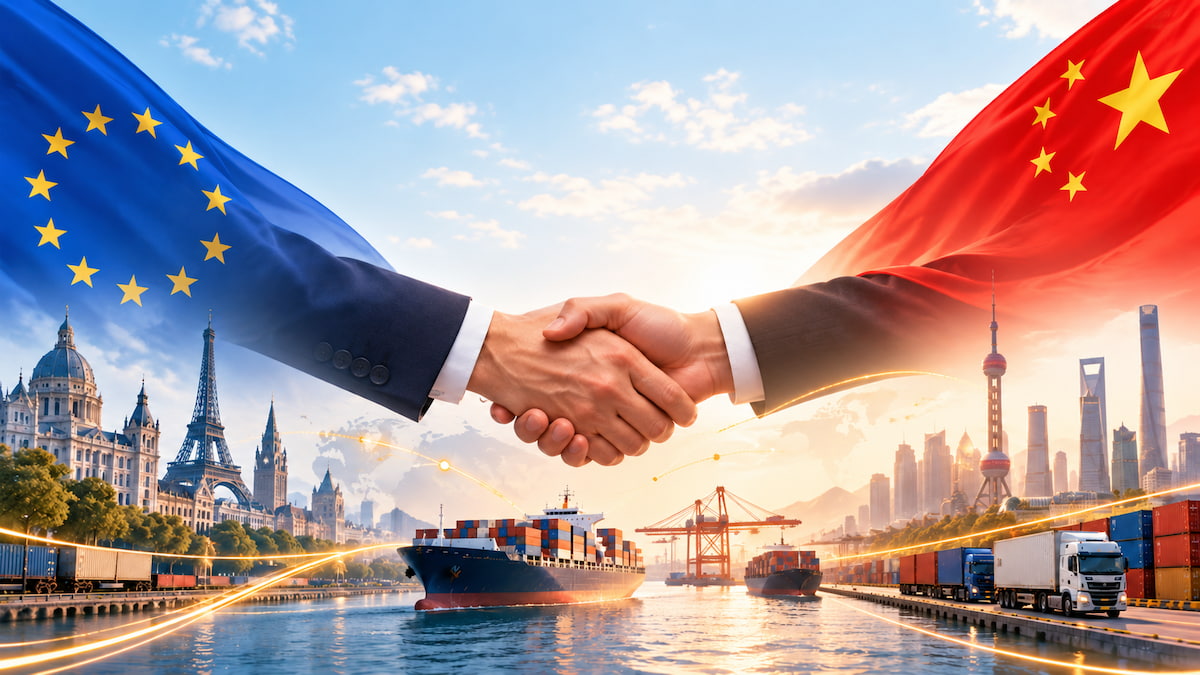
Trade wars have no winners. Initiating trade disputes on untenable logic is in itself an extremely irrational act, and this should serve as a profound wake-up call for some EU policymakers in Brussels who insist on taking a hard line toward China. China and Europe’s industrial chains are highly interwoven. Europe has long run a surplus in services trade with China and has substantial investments in China; goods are exported to all parts of the world, including Europe, and imports from China are inexpensive and high-quality, which can help Europe curb inflation and benefit people’s livelihoods. China’s technological and industrial-chain advantages in the new energy sector can promote Europe’s energy transition. These advantages should not become casualties of the EU’s proactive initiation of trade disputes.
Europe currently faces complex predicaments and cognitive anxiety. Europe is now under pressure both internally and externally, with overlapping crises: externally, it is deeply entangled in ideological rivalry between Europe and the United States, the struggle over discourse power in international rules, and geopolitical conflicts; internally, it has many problems, including social fragmentation and polarization of public opinion; and it also risks falling behind in the global process of new technological transformation. The Alternative for Germany’s (AfD’s) successive gains in the state parliamentary elections in Saxony-Anhalt and Mecklenburg-Western Pomerania show that this crisis of subjective perception brings overall uncertainty, and such uncertainty will spill over into the economic and trade spheres. Therefore, abandoning confrontational thinking, returning to rational consultation, upholding existing international trade rules with the utmost sincerity, focusing on problem-solving, and accommodating the interests and demands of both sides are the realistic path for China and Europe to resolve trade disputes.
At the micro level, China and Europe can communicate and consult on each point of contention—such as new energy vehicles, critical raw materials, trade deficits, and cross-border e-commerce—and formulate targeted, implementable, concrete solutions to quickly resolve current trade differences. At the macro level, Europe should rise above the limitations of a single dispute and consider specific trade differences within the overall framework of market access, investment rules, and the bilateral trade and economic system. On the basis of resolving bilateral issues, it should tap the norm-setting effect of cooperation that can serve as a regional and even global model.
Making the pie bigger together is clearly more attractive than unilaterally creating friction. China and Europe have already reached much consensus in structural areas involving global and bilateral issues, and there is ample room to advance and substantiate cooperation. Even in the new energy vehicle arena, which is the most sensitive in Europe, many mainstream European automakers have clearly recognized that learning Chinese technology, drawing on Chinese experience, and deepening cooperation with China are the only way for them to complete their industrial transformation; they regard head-on competition with Chinese companies as a “testing ground” for entering the global market. Rational voices in Europe have seen the “window of opportunity” in China-EU trade and economic relations. They should therefore ground their approach even more in the common needs of both sides, link trade consultations with structural and long-term cooperation, and open the “door of opportunity” for two-way opening-up and mutual benefit, so as to achieve long-term stability and high-quality development of China-EU trade and economic relations.
Translated by Zhao Yiming