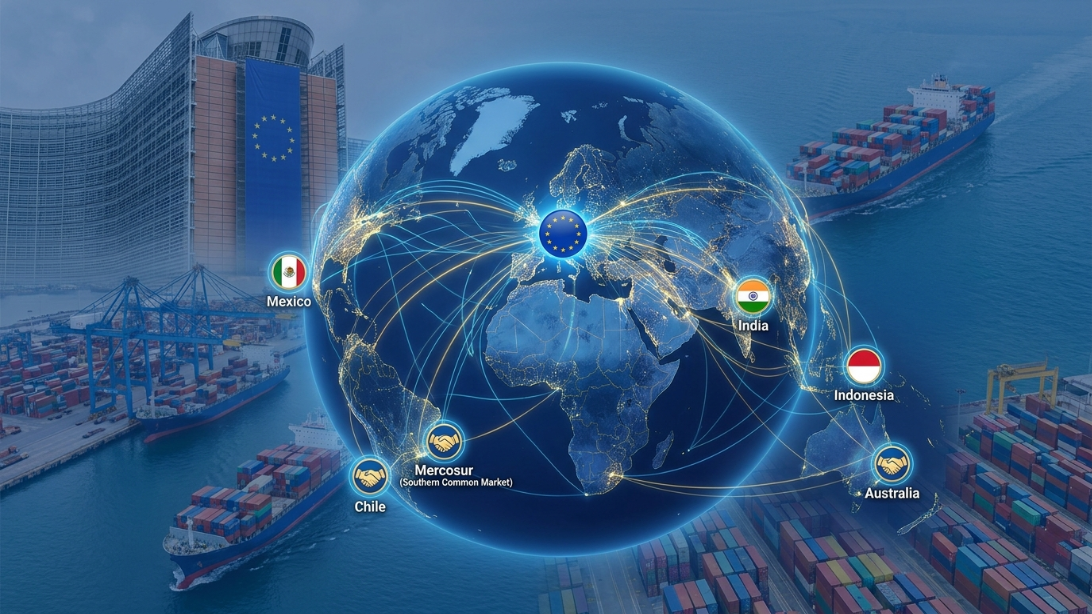

Since the beginning of this year, the EU has successively signed free trade agreements with Mercosur, India, and Australia. As of mid-April, the EU had 82 active trade agreements with countries and regions around the world. These include traditional frameworks—such as free trade agreements, economic partnership agreements, customs unions, and association agreements—as well as newer forms like investment and digital trade pacts, forming a vast, multi-layered, and diverse system.
Currently, Trump’s “Neo-Monroe Doctrine” and “America First” policy are rapidly eroding the established order of the global economy and international politics. This has compelled Europe's political elites to profoundly adjust their strategic perceptions and existing policies, accelerating the development of their external trade system. In particular, the EU is forging economic alliances with “middle powers” in Latin America and the Indo-Pacific to jointly navigate profound global shifts, while simultaneously seizing the opportunity to strengthen its influence over the Global South.
The Accelerating Geopoliticalization of Trade Policy
Over the past decade, the economic growth dividends generated by globalization have gradually diminished, while accumulated contradictions have come to a head. Marked by turning points such as Brexit and the election of Donald Trump in 2016, the “post-Cold War order”—driven by economic liberalization and regional integration—has begun to crumble. Globalization has suffered severe setbacks, leaving the EU increasingly mired in internal and external difficulties. This was particularly exacerbated by the energy crisis triggered by the outbreak of the Ukraine crisis in 2022, which dragged the EU and major European powers like Germany into a quagmire of stagflation and industrial hollowing-out.
Meanwhile, with breakthroughs in emerging disruptive technologies and the rise of advanced manufacturing, international competition over technology and economics has intensified. Europe has gradually fallen behind China and the United States, whether in R&D for artificial intelligence, quantum computing, and ICT (Information and Communications Technology), or in the development of industries such as new energy and digital platforms, placing it at a disadvantage in the geopolitical economic game among the three powers. To make matters worse, friction and conflicts between the US and Europe have also increased.
Under this mounting pressure, European political elites have developed a siege mentality, forcing them to reflect deeply and significantly altering their strategic outlook and policy intentions. Upon taking office in late 2019, European Commission President Ursula von der Leyen proclaimed the need for a “geopolitical Commission”, while High Representative Josep Borrell declared that “Europe is undergoing a geopolitical awakening”. Following her reappointment in late 2024, von der Leyen established the Directorate-General for Trade and Economic Security within the Commission. These shifts indicate that EU decision-makers are no longer blindly clinging to the liberal of globalization as the ultimate truth; instead, they are increasingly scrutinizing the global landscape through the lens of geopolitical competition.
Driven by the strategic anxiety triggered by these shifting dynamics, EU decision-makers are increasingly purposing trade policy. What was once a technical instrument for regulating the cross-border flow of goods and services is now being wielded as a vital tool to safeguard its “economic security” and engage in geopolitical game.Within the EU' s trade policy toolkit, negotiating external trade agreements remains a power it autonomously controls. To simultaneously counter the geopolitical pressures from both China and the US, the EU has begun to exercise this authority with growing frequency. It is actively reaching out to economies beyond the two superpowers—particularly “middle powers” in the Global South, such as India and Mexico—to explore cooperative opportunities, including the establishment of free trade agreements.
Diverse Forms of Trade Agreements
The EU has long championed the international multilateral trade system and the global governance architecture represented by the World Trade Organization (WTO). This aligns perfectly with its self-image as a “normative power” and its commitment to building a “rules-based international legal order”. However, following Donald Trump's first term, the cornerstone of the multilateral trade system—the WTO' s dispute settlement mechanism—was swiftly dismantled. European political leaders soon realized that the “rules” they once revered as sacred seemed to have lost their potency, and the vision of advancing trade liberalization through WTO reform faced significant hurdles.
The 14th WTO Ministerial Conference, which concluded on March 30, further underscored the dilemma of the multilateral system when the “ Yaoundé Package ”—a reform proposal the EU had pinned high hopes on—failed to gain approval. Faced with this reality, EU political leaders have been compelled to look beyond the universal multilateral framework. They are now actively exploring smaller-scale bilateral or multilateral cooperation structures. By leveraging the sheer scale of the EU Single Market, they aim to attract economies outside the bloc—particularly key players in the Global South—to negotiate various forms of trade agreements, thereby advancing mutual trade liberalization and expanding the EU' s external commercial interests.
To this end, the EU has pioneered three new forms of agreements to complement its comprehensive bilateral trade deals that span macroeconomic sectors and industries.The first category consists of multilateral agreements outside the WTO framework, such as the EU-Central America Association Agreement and the EU-CARIFORUM Economic Partnership Agreement. Under these deals, participating parties open their markets on preferential terms, albeit with limited depth and scope.
The second is the “nested” dual-track trade agreement, where parties simultaneously negotiate a comprehensive agreement alongside an embedded, limited-scope provisional agreement. The former covers the majority of economic sectors, encompassing trade, investment, and political cooperation. However, it requires ratification by the European Parliament, the EU Council, and the parliaments of all EU member states—an extremely slow approval process that often drags on for years. In contrast, the latter covers a select few sectors involving pure import and export matters and can be rapidly implemented once approved by a qualified majority vote in the EU Council. Once the comprehensive agreement enters into force, the two merge into a single framework. Since early 2025, the EU has concluded comprehensive agreements with Chile, Ukraine, Indonesia, India, Australia, Mexico, Switzerland, and Mercosur. Among these, the deals with Chile, Mexico, and Mercosur are “nested” dual-track agreements; the provisional agreement with Chile entered into force in February 2025, and the one with Mercosur took effect this May.
The third category comprises sector-specific agreements, primarily including investment agreements and digital trade agreements. The former aims to build a stable, transparent business environment and legal framework to attract investment, while the latter focuses on emerging issues tied to e-commerce platforms, such as the regulation of cross-border data flows and the protection of personal privacy. Currently, the EU has signed an investment protection agreement with Indonesia and its digital trade agreement with Singapore has entered into force. Digital trade negotiations are also underway with the United Arab Emirates, Indonesia, and the CPTPP (Comprehensive and Progressive Agreement for Trans-Pacific Partnership) bloc.
Currently, European political leaders believe that the US-led liberal international order and the “post-Cold War order” established after WWII are on the verge of collapse, while a new global order has yet to emerge. The world is currently in a “geopolitical window of opportunity” between the old and the new. In this chaotic and turbulent transitional period, the EU needs to strengthen its strategic autonomy, leveraging two key advantages to safeguard its strategic interests: the sheer size of its Single Market and the “Brussels Effect”—its ability to export rules and standards globally.
The vast and complex trade system that the EU is striving to expand is perfectly positioned to capitalize on these advantages, thereby protecting its “economic security” and broader strategic security. However, the rapid expansion of the EU’ s trade agreement network could have significant implications for China-EU economic and trade relations. Looking ahead, it is crucial for China and the EU to promptly launch negotiations for a new bilateral economic and trade agreement. This step is essential to ensure the steady, long-term development of China-EU relations and to achieve substantial progress.
Xin Hua, Director, EU Studies Center, Shanghai International Studies University; Deputy Secretary-General, Shanghai Association for European Studies
May 26, World Affairs
Translated by Zhai Ziyun